The New Standard for Image Processing Systems: Blue LED
Choosing the right LED lighting can be a challenge for industrial image processing beginners and even those with some experience. The challenges we face may be related to the environment, working distance, limited space or even an unusual product.
Nowadays, red LEDs are most in demand for the image processing industry for use in monochrome camera applications. The only possible reason for this is that users continue to buy what they are most familiar with or say it's red or it's different. We're not kidding.
Depending on the application, the product to be controlled should have more (or less depending on the application) contrast under red light (or not depending on the application), or using a monochrome camera with a higher spectral response for red light; Of course, there are situations where red is always the best choice. But these are generally not the reasons why a customer chooses red LEDs.
In fact, there is a better LED color available for general applications, BLUE. But we need to provide some concrete evidence as to why blue is now a better LED option than red.
To understand why red LED lights are so widely used, you need to look at the history of LEDs and the first monochrome cameras. The first practical use of LEDs was with the red LED, introduced in 1962. At this point, the density was so low that they were only useful for indicators.
Years have passed and new developments have helped make them useful for illumination in image processing applications. The price of red LEDs was relatively cheap when taking into account the life cycle and downtime due to degradation and failure in the intensity of other types of light sources.
The red LEDs could be strobed at a higher current, helping to reduce camera pixel blurring of moving parts and further extending the life of the LEDs. Red LEDs were also perfect for most monochrome cameras because they had a higher spectral response in the infrared to red range at the time. Blue LEDs were higher priced and the spectral response of the CCD in most, if not all, monochrome image processing systems was low in the 470 nm (blue) range, not to mention the very low lumen output of blue LEDs.
Then came the invention of white LED. White LED burst onto the scene in the mid-90s. This new technology relied on using a blue LED with a phosphor coating to create white light. This new technology had its share of problems with phosphor degradation, which resulted in short LED life expectancies. White LEDs were also typically priced 5-10 times higher than red LEDs. At this point, Philips came out with its new Lumiled Luxeon LEDs. For a 1 watt white LED with 21 lumens output, they were advertising LED lifespan maintaining an average of 70% output after 50K hours. This was a turning point for white LEDs in the image processing industry, especially when it came to color applications, but it also paved the way for the use of blue high-output LEDs in monochrome applications.
1. Blue vs Red for Cameras
Above, we talked about the first release of the cameras and the status of the red LEDs.
“Red LEDs were also perfect for most monochrome cameras because they had a higher spectral response in the infrared to red range at the time.”
Now let's go back to today and look at the current data.
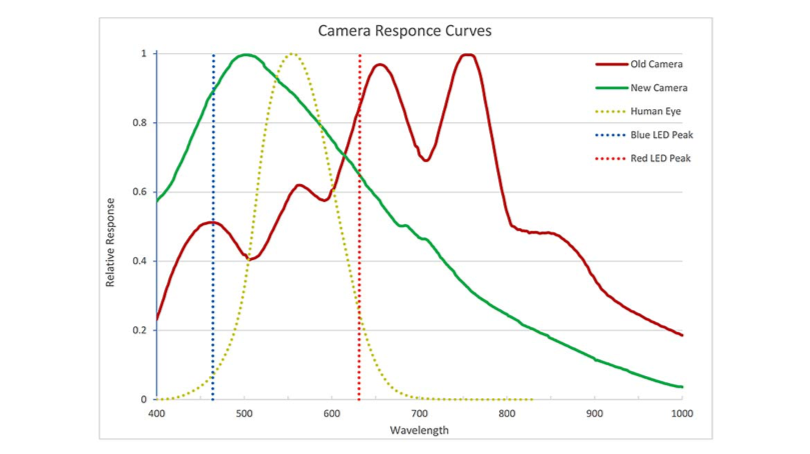
When you look at the spectral behavior of the new cameras, indicated by green, you will see that it is maximum in the 480-510nm range, so what color do you think this corresponds to? Of course Blue.
Meanwhile Red color is 620-760nm.
2. Blue vs Red in terms of LED Power
Lumen is a unit in which luminous flux is measured. The lumen unit refers to the amount of light perceived by the human eye. Wikipedia
Based on previous definitions and an understanding of the primary market of LED manufacturers, it is not difficult to understand that the unit of light was and continues to be the lumen. Manufacturers produce their products primarily to replace car headlights and taillights, facility lighting, home lighting, museum lighting, flashlight bulbs, signal lighting, and a variety of other types involving human image processing. Almost all LEDs sold are intended for human vision. For these reasons, LED manufacturers measure their products in lumens. However, image processing systems are different from the human eye.
The imaging chip in an image processing camera has a different spectral response curve than the human eye (see Chart 1 ), so the better unit of measurement would be radiant flux (watts).
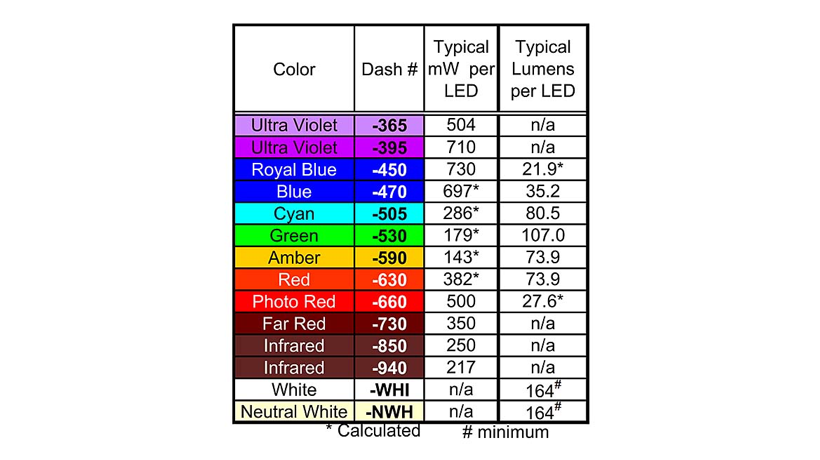
Image processing lighting manufacturers should adopt the radiant flux (watt) or milliwatt unit of measurement so that a uniform standard can be used for light output comparison. For example, unlike cameras, the human eye cannot see infrared, so for most of us, this does not count as light, so the lumen of an IR LED is zero.
The milliwatt standard would be based solely on the power output of the LED, and since LEDs have a narrow spectral output, a customer could apply this information directly to a camera's spectral response curve.
This brings me to the point I made earlier, most of the new imaging systems produced have imaging chips with the highest spectral response in the 450-470 nm range.
You'll notice that the typical output of a blue LED is only 35 lumens and a red LED is 74 lumens, but these values are based on the spectral response of the human eye. Since the lumen output of LEDs is the norm for light output and milliwatt output is more difficult to calculate, most visual lighting companies do not see the need for replacement. When you look at the actual milliwatt output, you notice in Table 1 that the blue LED has 1.8 times more mW output than the red LED. Based on this information and the fact that most newer monochrome visual cameras have a higher spectral response in the blue range, we find that blue (470 nm) is the best choice.
3. Red vs Blue, the Chief Enemy of LEDs in Terms of Heating
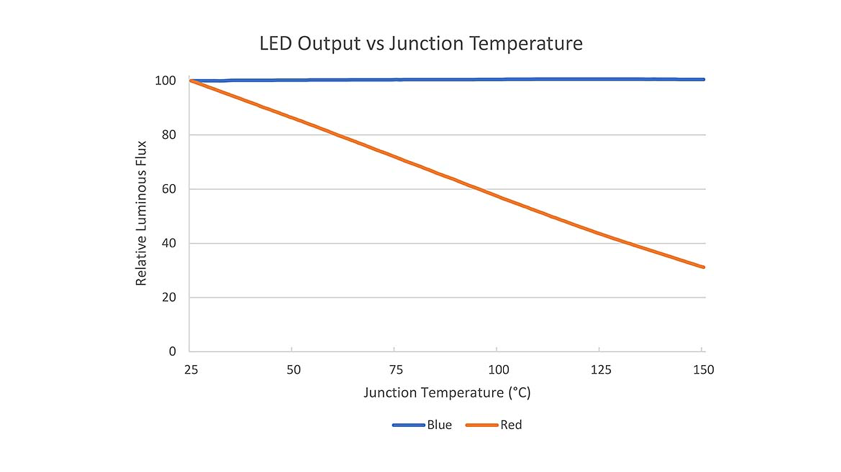
Another reason to choose blue LEDs is their stability over temperature. Chart 2At , the blue LED output is stable across the operating temperature range, but the red LED has an output droop of 14% at 50°C and 43% at 100°C. This creates problems where changes in intensity cause false faults as the light warms up or even having to adjust control parameters when moving from winter to summer months. Once again, it shows that blue LEDs are superior to red with today's camera and LED advancements.