Telecentric Lens Measuring Systems Vs SmartAxis
Telecentric lenses have been preferred as a standard solution in precision camera measurement applications for many years. However, new technologies that have developed in recent years have begun to offer modern and effective solutions to the problems caused by this traditional approach.
In this article, we will examine the advantages of innovative measurement systems that stand out compared to traditional telecentric lens measurement systems.
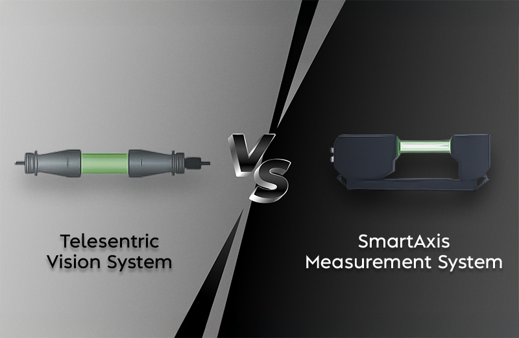

Partial schematic diagram of image processing system using ordinary telecentric lens
Partial schematic diagram of the SmartAxis series throughput sensor system
1-) Factory Calibration and Certification Advantage
The calibration process to achieve accuracy in telecentric systems is quite complex and requires expertise. The task of translating pixel-based results into metric information is left to the user. Although this process is initially defined as just entering a multiplier for most users, it never gives the desired result. This may lead to both loss of time and additional costs.
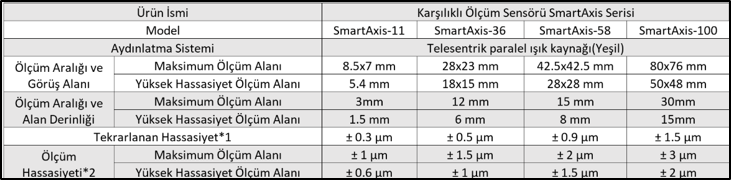
Modern measuring systems, on the other hand, come pre-calibrated at the factory and come with a calibration certificate. In this way, users can be sure of measurement accuracy and start using their systems directly without the need for additional calibration.
In addition, users can know the exact accuracy values as follows.
2-) Compact Design, Easy Integration and Precise Assembly
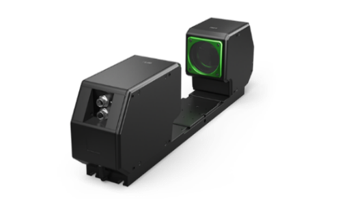
Telecentric lenses are generally large and heavy, which can make integration in limited spaces difficult. Smartaxis, on the other hand, offers a more compact design and can be easily integrated.
Ultra-small size design better fits a variety of compact automation equipment and enables installation in tight spaces.
In addition, when trying to make a measurement system with telecentric systems, the need for precise positioning always causes erroneous measurements.
However, even if the receiver and transmitter of Smartaxis need to be assembled separately due to mechanical requirements, the precise alignment software guides the user during the assembly process. Optical axis alignment calibration can be performed, allowing simple and accurate adjustment of the optical axis, thus easily achieving high-precision measurements.
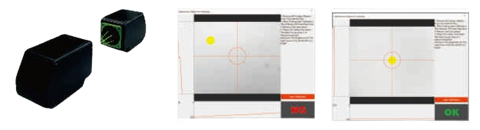
This software both speeds up the assembly process and minimizes the margin of error.
3-) Measurement-Oriented Software Support
2D Image Measurement Systems are equipped with software tools specifically focused on measurement.
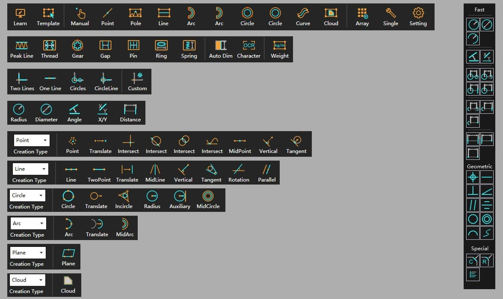
These software provide special analysis and error control functions during the measurement process, allowing users to obtain easier, accurate and repeatable results. In traditional telecentric lens systems, such measurement-oriented software support is limited, and it is necessary to find indirect and complex solutions with standard image processing tools.
In order for users to save the reports of their measurements, these software provide report output including special measurement statistics.
To summarize, Although telecentric lens systems continue to offer an effective solution for precision measurement applications, modern camera measurement systems attract attention with both cost and performance advantages.
Thanks to their factory calibrated structure, precise alignment software and measurement-oriented software tools, these new technologies constitute an important alternative for users looking for easier integration and high precision.